A Return Visit to the Birches at Houdek Dunes

I visited the Houdek Dunes Natural Area in Leelanau County on Saturday. Spring has yet to really take hold. I saw little new growth anywhere. But that’s not why I went there. Houdek Dunes has a number of amazing birch trees, some of which are over 100 years old – unreal for a birch. For some reason, the birches at Houdek Dunes tend to live much longer than normal. Many of the trees have succumbed to old age and are lying on the ground. Those are the ones I came to see.

As I walk through our forests, more and more I am drawn to the downed trees. The fallen trees often have a sculptural character to them.

Throughout the preserve, decomposing birch trees lie on the ground, slowly merging into the earth. The sapwood and heartwood decay first, leaving the birch’s bark as a hollow witness to a tree that once stood tall.

The decompostion process is hastened by bugs, worms and fungi. I found this fungus on the end of a decaying log worthy of a photograph. I think it is called bitter oyster (panellus stipticus), but I can’t be sure of that. No matter, I found it beautiful.

This old tree is a favorite of mine. Whenever I visit Houdek Dunes, I make sure to pay my respects. How much longer before this tree succumbs to old age and begins the process of becoming soil?

You can see photos from my previous visits to Houdek Dunes here and here.

Teichner Preserve in Winter

Teichner Preserve is a nature preserve owned by The Leelanau Conservancy. As I explained in a post in 2019, the property was donated to Conservancy by CBS News reporter Martha Teichner, whose family lived in northern Michigan before Teichner and her mother moved to East Grand Rapids (following the death of her father). It was in Grand Rapids where she got her first on air job in television news (WZZM). The Detroit Free Press has a wonderful story about Martha Teichner, which you can read here.

I have been drawn to the Teichner Preserve for quite some time. It is a small area with a short trail that leads to Lime Lake. What draws me there are the cedar trees on the shore of the lake and the mass of exposed roots that hold them up (barely). The trees lean every which way while the roots keep them from falling into the lake. In 2021, a photo I took in the Preserve, which I called “Gathering Place,” was published by Lenswork Magazine in its book “Our Magnificent Planet.”

I have never visited Teichner Preserve in the winter, that is until yesterday. Other than a deer or two that left tracks in the snow, it did not appear that anyone had taken the trail in the past several days.

The snow was deep, but the pathway was beautiful as snow flocked the trees and bushes.

I was eager to see the what the scene on the shore looked in the snow. It did not disappoint. Here are three photos of one of my favorite places in northern Michigan.

Get the Cliché Out of the Way

Suzanne Fritz-Hanson, who co-hosts the Everyday Photography Every Day podcast with photographer Michael Rubin, coined the phrase “get the cliché out of the way” to suggest how photographers should deal with the urge to take the obvious photo that everybody snaps. Who can resist taking a photo of Tunnel View in Yosemite Valley or a sunset over Lake Michigan? And why shouldn’t you take your own photo of the iconic scene, even if it is a cliché? Once the cliché is in the bag, you can move on to shooting popular subjects from unusual points of view and creating original images.

I recently returned from spending a week with my family at my frequent haunt, Sleeping Bear Dunes National Lakeshore. The focus of the week was spending time with my son and his family, but I did get out in the early morning and on a couple of evenings to take some photographs. In the limited time I had, I fell back on the clichés, photographing things I have seen countless times before. My excuse is that I was working with a new camera, learning how to use all the new features. And besides, it was fun. So here’s a mishmash of photos from the trip.

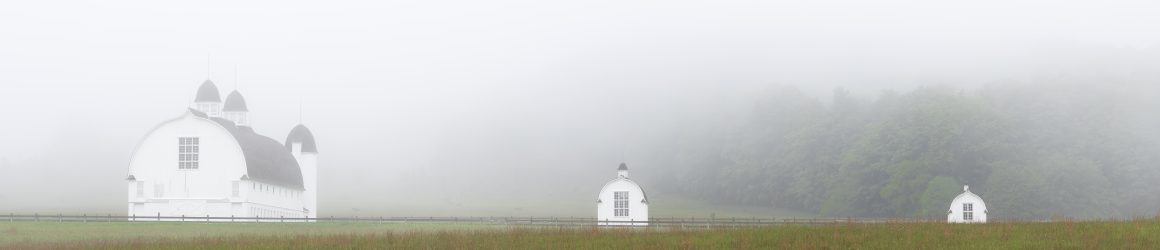
What could be more cliché at Sleeping Bear than a photo of the iconic barns on the D.H. Day farm? I was there on two foggy mornings and couldn’t resist.

This tree that stands in Narada Lake may not be an iconic image, but it is one I frequently photograph, hoping to find the right light and right angle to make a compelling image. I rarely succeed. But this sunrise with bands of clouds made the scene worth taking.

On another foggy morning, I headed to North Bar Lake. The fog had mostly lifted but the reflection of the trees and the dune in the water and the curvature of the cloudbank drew my attention.

The fog lingered on the south end of North Bar Lake. There, I noticed a pair of Sandhill Cranes walking along the beach and approached them cautiously to get this photograph.

If you search for “Teichner” on this website, you’ll see that I have photographed the cedar trees at the Teichner Preserve several times in the last six years. Perhaps the site is becoming cliché for me, but I am drawn to the location and keep looking for new perspectives on the scene. (If you are looking at this on a computer rather than a phone, click a photo to seen an enlarged image.)

Another site I return to often is the Basch farmstead in the Port Oneida Rural Historic District. The simplicity of the house and the granary continue to draw my eye. The light on this evening reminded me of the light in some of Edward Hopper’s paintings.

One evening when the conditions seemed right, I headed to the beach at Port Oneida to photograph that mother of all clichés, a sunset over Lake Michigan. When I pulled into the parking area, I was captivated by the dappled light on the trees.

On the shore, I waited and waited for the ball of the sun to appear. It never did. Others who were on the beach with me impatiently left, but I waited around to see how the setting sun would light up the clouds. Taking a long exposure, I captured a beautiful, soft glow as the sun slipped below the horizon – a photo I would consider more than a cliché .

“Woodland Studies” Update

“Woodland Studies,” an exhibit of six of my photos, opened today at the Glen Arbor Arts Center in Glen Arbor, Michigan. The exhibit will run until April 13. The exhibit can be viewed online at https://glenarborart.org/events/exhibit-woodland-studies/. That page also has a link to a video of a conversation about the exhibit that I had with Gallery Manager Sarah Bearup-Neal. I have also embedded that conversation below.

[Note: “Woodland Studies” is no longer available on the Glen Arbor Arts Center website. You can see the photos in the exhibit on my website by clicking here.]

I am grateful to the Glen Arbor Arts Center for hosting this show and especially to Sarah Bearup-Neal for guiding me through the process of preparing my first exhibit.

Views of the Leelanau

After months of working at home, we spent a week physical distancing in Leelanau County.  I rose early each morning to shoot as the sun rose.

Sunrise in Glen Haven

One of my goals for the week was to practice panoramic photographs.  It involves taking several overlapping photographs and stitching them together using Photoshop.  I had some pretty dramatic sunrises looking across Sleeping Bear Bay toward Pyramid Point.

_MG_6280-Pano

_MG_6379-Pano

Glen Haven was once a bustling port.  One of the remaining buildings in the village the Glen Haven Canning Company, owned by D.H. Day.

_MG_6162-Edit

_MG_6166

Dew on the beach grass creates specular highlights in this photo.

_MG_6168

Even without dramatic clouds, the sunrise on Sleeping Bear Bay is breathtaking.

_MG_6118-Edit

Finding My Roots

Lately, I have been intrigued by the roots of trees. So another goal for our trip was to try to take some interesting photos of them.  I visited Bass Lake, where the shore is lined by cedar trees.

_MG_6635-HDR-Edit-Edit

_MG_6629

_MG_6645-HDR-2

_MG_6685-Edit

_MG_6659-Edit-2

I also visited the Teichner Preserve on Lime Lake where cedars again line the shore.

_MG_6420

_MG_6424-Edit-Edit

_MG_6428-Edit

These cedar roots are the last thing keeping these three trees from falling into the lake.

_MG_6482-Edit-2

I took this shot along the Sleeping Bear Heritage Trail in Glen Arbor.

_MG_6187

Port Oneida Rural Historic District

I return frequently to the Port Oneida Rural Historic District, where the farms were established in the late 1800s and early 1900s.  For a time, the National Park Service was letting the farms decay, with the intention of turning Sleeping Bear Dunes into a wilderness area.  That plan has changed, and with the help of Preserve Historic Sleeping Bear, a not-for-profit, the farms buildings are being restored and preserved.

This is a panoramic photo of the outbuildings of the Thoreson Farm.  The red building is the granary.

_MG_5853-Pano-Edit

I have taken so many photos of this granary, one of the few remaining buildings on the Peter and Jenny Burfiend Farm.

_MG_5710

Omena, Michigan

Omena, Michigan, is a tiny town on the Leelanau Peninsula, between Sutton’s Bay and Northport.  It has a few charming buildings, including the local post office . . .

_MG_6739

and the Omena Bay Country Store, which has unfortunately closed.

_MG_6813

The Omena Presbyterian Church was dedicated in 1858.  It holds services only in the summer, with visiting ministers.

_MG_6760-Edit

But, services were suspended this year because of the Covid-19 virus.

_MG_6776

Photographing the church, I noticed the cemetery behind it.  The cemetery was unlike any I have visited before.  Most of the graves were marked by blank, roughcut  headstones.

_MG_6791

A marker explained.

_MG_6779-Edit

Sunset over Lake Michigan and South Manitou Island

One of our traditions when vacationing in Glen Arbor is watching the sun set each evening.  The show was dramatic on our second evening,  as the sun set amidst a clearing storm._MG_5837-Edit-5 Noise reduction

Each subsequent evening offered a different show.

_MG_5667

_MG_5688

_MG_5750

_MG_6276

_MG_6208-Pano

_MG_6582


Favorite photos of 2019

As the year comes to a close, it is a good time to look back at the year’s batch of photos and assess how I did. Ansel Adams said, “Twelve significant photos in any one year is a good crop.” I can’t claim significance for these twelve photos but they are my favorites of 2019.

Each time I look at the photos, I see imperfections, which to me is a good sign since it tells me I am learning my craft, both the field work and the post processing. I have edited most of these photos several times with the goal of attaining what I envisioned when I was on location. Hopefully, they do not look over-processed to you.

_MG_0029 BW 16x9
The first snowfall comes to the Absaroka Range on the east side of Paradise Valley, Montana, in September.

_MG_0162-orton-2
Sheepeater Canyon in Yellowstone National Park.

_MG_0429-Pano
Undine Falls in Yellowstone National Park. This photo is a vertical panorama, combining three photos.

_MG_1444
The Gibbon River as it approaches the Virginia Cascades in Yellowstone National Park.

_MG_7381-bw
The granary on the Pete and Jenny Burfiend farm in the Point Oneida historic farm district of Sleeping Bear Dunes National Lakeshore.

_MG_7407
Pete and Jenny Burfiend bought their Point Oneida farm in 1882. They initially lived in a log cabin, but sometime in the 1880s hired Martin Basch to build this farmhouse.

_MG_7700
Warm morning light breaks through the forest at the Houdek Dunes Natural Area on the Leelanau Peninsula in Michigan. The Houdek Dunes Natural Area is owned by the Leelanau Conservancy.

_MG_8781-HDR
The Roosevelt Arch at the North Entrance to Yellowstone National Park in Gardiner, Montana. Mount Electric is in the background.

_MG_8840
A huge wave hits the breakwater at Point Betsie, north of Frankfort, Michigan.

_MG_8914
The Gardner River as it flows out of Yellowstone National Park to the town of Gardiner (spelled differently than the river), Montana, where it flows into the Yellowstone River.

_MG_9517
I came upon this doe and her two fawns on a foggy morning near Clarksville, Michigan. They were kind enough to allow me to do a U-turn so I could shoot out the driver’s-side window of my car.

_MG_9938
The Royal 7 Motel in Bozeman, Montana. This is a composite of several photos I made to balance the light. I wanted to capture the garish light of the neon sign and well as the warm, inviting light in the windows of the motel lobby. I loved the reflection of the sign on the wet pavement. (I stood out in the rain to get the shot.)

Birches at Houdek Dunes

Yesterday, I explored the Houdek Dunes Natural Area. Houdek Dunes is five miles north of Leland on M-22. The property is owned by the Leelanau Conservancy. It comprises 330 acres and has about 3 miles of trails that take you through open dunes and several types of forests. What stood out to me yesterday morning were the birch trees, many of which, protected by the dunes, have lived for over 100 years. That’s quite unusual for a birch tree. With their white bark, the birches caught my eye for this series of photographs.

Houdek Dunes 7660

Houdek Dunes-7685

Houdek Dunes 7220-2

Houdek Dunes-7726

Houdek Dunes-7730

Houdek Dunes-7735

Houdek Dunes-7736

Cedar Roots

Cedar roots on the shore of Lime Lake in the Teichner Preserve in Leelanau County.  CBS News correspondent Martha Teichner donated the first 20 acres for this 43-acre preserve and then mortgaged her apartment in Manhattan to join with the Jean Raymond Family to double its size.  Teichner was born in Traverse City and graduated from East Grand Rapids High School, before attending Wellesley College and getting an MBA from the University of Chicago.Cedar Roots - Teichner Preserve 7781