Earlier this week, I traveled north to the Leelanau Peninsula to see what winter has brought to northwest Michigan’s shoreline. I began my exploration in Frankfort, Michigan, where the Betsie River flows into Lake Michigan. Snow and sand were piled up on the beach while the lighthouses that mark the opening of the harbor were covered in ice.
On the shoreline was a collection of benches. They faced the town, but one bench stands sentinel, looking towards the lake.
A few miles north of Frankfort, is the Point Betsie Lighthouse. I have photographed here many times. It is especially interesting in the winter when the ice forms of the trees and the breakwaters.
North of Frankfort, after you enter the Sleeping Bear Dunes National Lakeshore, you cross the Platte River. I followed the river down near where it enters Lake Michigan. As it makes a turn to the lake, it cuts through an area of dunes.
Sand Dunes on the Platte River
Another ten miles or so north is Empire, Michigan. As you stand on the beach, Empire Bluff is to the south, while the Sleeping Bear Dunes are in this distance to the north.
Empire BluffSleeping Bear Dunes
I stopped near the Dune Climb to photograph the frozen mill pond and the snowy dune.
Sleeping Bear Dunes
I finished my trip with a visit to Good Harbor Bay, where Shalda Creek flows into Lake Michigan. It always interests me to see the path the Creek cuts to make its way to the lake.
Winter finally came to Michigan in a big way. This past weekend in Grand Rapids, we received about 17 inches of snow. Prior to that, the snowfall had been minimal. That was the case in the northern lower peninsula, as well. Frankfort, Michigan, in Benzie County, had just 2.5 inches of new snow in December, 21 fewer inches than normal. So far in January, Frankfort has received 21.8 inches.
With this blast on winter, I had to drive north to check it out and do some photography. On Wednesday, I visited the Point Betsie Lighthouse, just north of Frankfort, perhaps one of the most photographed lighthouses in Michigan. I arrived about 8:45 a.m. and had the place to myself. No wonder. The wind was gusting to 30 mph and the windchill was about ten below zero. I was able to stand outside for about 10 minutes before my fingers were so cold, it was hard to operate the camera. I retreated to my car, put on some heavier gloves, put foot warmers in my boots and headed up to the Sleeping Bear Dunes National Lakeshore, where I photographed in woodlands, where I was protected by the wind. My 10 minutes in the deep freeze were productive, however. Here are the keepers among the photos I took.
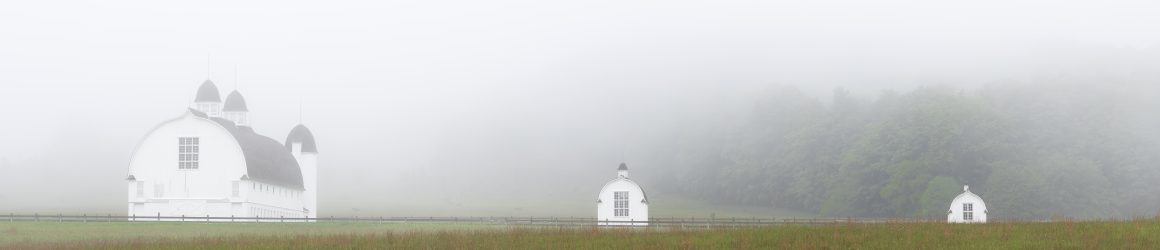
I had another chance to go north this weekend to try my hand at a little night sky photography. The last “Super Moon” of the year arrived on Thursday. As a bonus, mid-August is the peak of the Persied meteor shower. So, I planned a shot of the full moon the following night right between the silos of the D.H. Day Barn at the Sleeping Bear Dunes National Lakeshore. I used the Photopills app to determine where I needed to stand and the time I needed to be there to shoot the moon in all its glory above the barn. I was able to reserve one of the last available campsites at the D.H. Day campground and headed north.
In the afternoon, I used the augmented reality feature of Photopills at the D.H. Day farm to confirm that the shot would work. The photo below hints at the problem I would encounter. The wispy clouds in the sky are cirrus uncinus clouds. In Latin that means “curly hooks.” The clouds are commonly called “mare’s tails,” and are precursors of rain.
The sky was filled with mare’s tails. Things weren’t looking good, but I had several more hours before sundown and moonrise.
I decided to watch the sunset from Van’s Beach in Leland, Michigan. While waiting for the show, I snapped some photos of the boats in the harbor. The reflection of a sailboat’s mast caught my eye. I watched the reflection as it morphed with each passing boat.
It became clear that there would be no great sunset show and likely no shot of the moon over the D.H. Day barn. The clouds in the west were headed my way, fulfilling the prediction of the mare’s tails. I took a photo of the entrance to the harbor and then set upon my way, hoping the skies would be clear 20 miles to the southwest.
No such luck. At the D.H. Day farm, the sky was thick with clouds. I determined to go with my plan B, a shot of the Point Betsie lighthouse. Point Betsie was another 24 miles to the south. On the way, I stopped by the beach at Empire. There’s a small lighthouse there in the middle of a parking lot. When I got there, the parking lot was full of revelers enjoying the evening. The night was dark but there was a faint reflection on the water. An 11 second exposure looking into the darkness revealed what was barely visible to the naked eye.
Finally, I made it to Point Betsie. My goal was to get a shot of the light house with the lamp lighted. The challenge is that the lamp is so bright compared to the lighthouse itself that if you expose for the lighthouse, the lamp gets blown out and has no detail. But, I had a plan.
Every lighthouse has its own “signature.” Some lights rotate, some are stable. Some flash, while others stay lit constantly. The Coast Guard publishes a list of the signatures of every lighthouse and buoy in the country. I knew from the list that the Point Betsie light flashed white for one second every ten seconds. After much experimentation, I discovered that a 3.5 second exposure allowed for a proper balance between the lighthouse itself and the lamp. But the key was not having the shutter open for the full one second the lamp was on. I learned to open the shutter shortly after the lamp lit so that it was on for probably just a half second or less during my exposure. I was helped in getting a proper balance by the moon, which peaked through the clouds, lighting the side of the building. I augmented the moon’s light with a small light panel.
The photo reminds me of an Edward Hopper painting. Hopper, of course, lived and painted for many years on Cape Cod, an area that resembles the Leelanau Peninsula in many ways. His work has influenced many photographers.
Mission accomplished, I drove back to the campground and crawled into my sleeping bag about 1:30 a.m. I was awakened briefly at 3:00 a.m. by the sound of raindrops hitting my tent fly. Never doubt those mare’s tails!