The weather forecast for this weekend called for the first snow of the season. Indeed, it happened today, though there was no accumulation (yet) to speak of. But, looking at the forecast on Saturday morning, I decided that I needed to get out and photograph some of the last vestiges of fall. I drove to Seidman Park and walked along Honey Creek. Most of the leaves had fallen, so I decided to photograph in black and white.
I have been visiting Seidman Park long enough to remember when this tree was still standing.
Though it lives no longer, the tree continues to capture my attention as it goes through the stages of decomposition.
Along the banks of the creek, I found some plants with vibrant red leaves that stood out from the brown leaf litter below.
I haven’t been able to identify the fungi in this next photo. In the drab setting, their white coloring is an attention getter.
The weather forecast called for our first frost of the season last night. That meant we would likely see fog rising from inland lakes. So I made the easy trip the Yankee Springs Recreation Area and Hall Lake. I have visited Hall Lake many times in the fall. This year the colors were not as vibrant as on past visits, but the fog made for some fun photography.
I arrived about an hour before sunrise and watched the scene reveal itself as the sky lightened and the sun, still below the horizon, painted the clouds.
I focused my attention on the smaller of two islands in the lake taking several photos as the sun began to illuminate it.
As I write this, 2024 is quickly coming to a close. Time once again to look back and select some photos from this year that I especially like.
This year was a little different from previous years because my main photography focus for the year was researching and preparing two lectures that I delivered in November at the Osher Lifelong Learning Institute (“OLLI”) at Aquinas College. The lectures were titled, “Editing Reality: The History of Manipulated Photography.” The first lecture dealt with the period before the digital age, while the second began with the digital age and got into the consideration of the impact of artificial intelligence on photography. I had a blast doing the research, reading a wide range of sources and, though the lectures are done, my reading continues to focus on the history of photography.
Incidentally, I was honored that OLLI sought my permission to use my photographs on their Fall and Winter Course Catalogs.
I am principally a landscape photographer who shoots in what some have termed, “the eyewitness tradition.” I edit my photos to create a realistic image that truthfully presents how I saw what was before me when I clicked the shutter. I do not use generative artificial intelligence or insert items into my images that were not before me. That said, this year I experimented making multiple exposure and montage images. There were two that I particularly liked.
I created this first image from three exposures taken of the side of a dumpster at the East Grand Rapids Public Works Facility. I blended them together in Photoshop. I rather liked the result.
This tree is one of my favorites. Standing alone in a farmer’s field, it reveals its majesty. On the day I took this photo, the sky was cloudless. While the sun was shining and the sky was a beautiful blue, to my eye, the sky offered nothing of interest. Photoshop now allows one to replace the sky with a menu of clouds. Doing so seems disingenuous and certainly would violate the eyewitness tradition I adhere to. Rather than create an artificial photo and present it as real, I chose to try something a little different – a composite of two photographs, one the photo of the tree and the field, the other an image of the bark of a tree for the sky.
Earlier this year, the Glen Arbor Arts Center put out a call for entries to a juried show titled “The Sky is Always There.” The prospectus called for entries that “move beyond direct representation, beyond portraits of puffy clouds.” I was eager to try to get something accepted for the show, but my photography is very representational. I gave it much thought but was coming up empty. Then, after creating cyanotypes of leaves and twigs with my grandchildren I got the idea of submitting photographs of the night sky processed as cyanotypes for this exhibition.
I selected three digital images – a moonrise, the Milky Way, and the northern lights – to create a triptych. From the digital files, I created monochrome negatives of each image. I used a mixture of ammonium iron citrate and potassium ferricyanide to sensitize hot-pressed, 100% cotton watercolor paper to UV light. Then I made contact prints from each negative by exposing the negative and paper to a UV light source. To deepen the blues, I bathed the final prints in hydrogen peroxide.
I am pleased to say that the juror selected my entry for the exhibit, which will run from January 10 to March 20, 2025, at the Glen Arbor Arts Center in Glen Arbor, Michigan.
Here’s a selection of more straightforward images that are among my favorites for 2024:
“Sunrise on Sleeping Bear Bay,” Sleeping Bear Dunes National Lakeshore
“Hall Lake Morning,” Yankee Springs Recreation Area
“Lake Superior Lakeshore from Above,” Pictured Rocks National Lakeshore
“Lake Superior Stones,” George Hite Dunes, Eagle Harbor, Michigan
“Milky Way,” Port Oneida Rural Historic District, Sleeping Bear Dunes National Lakeshore
“Northern Lights over White Lake,” Wabaningo, Michigan
“Hanging On,” Teichner Preserve: The Leelanau Conservancy
“Fall Foliage,” Howard and Mary Dunn Edwards Nature Sanctuary, the Grand Traverse Regional Land Conservancy
“Turkey Tail and Maple Leaf,” Houdek Dunes Natural Area: The Leelanau Conservancy
In the coming year, I will continue to research the history of photography. Of particular interest to me are cabinet cards created in the second half of the 19th century. I will also continue to deepen my understanding of generative artificial intelligence and its impact of the art of photography. And, of course, I will continue to get out with my camera in an effort to capture nature’s beauty.
Happy New Year
Here are links to my my year-end review of images in 2019, 2020, 2021, 2022 and 2024.
As I write this on the tenth day of November, fall has entered its final stages. The trees are done showing off, no longer flashing their brightly colored leaves. Their branches are now mostly exposed, revealing the superstructure of the forest. I traveled to northern Michigan this past week to spend a couple of days exploring the woods, looking for smaller, more intimate scenes that seem to become more evident when the trees stop showing off.
Most of the ferns in the forest were brown and withered. But, at Misty Acres in the Borwell Preserve in Benzie County, I found this bulblet fern that had found sanctuary in the bark of a tree.
At the Houdek Dunes Natural Area in Leelanau County, my eye was attracted to the yellow plant and the green pine tree seemingly enjoying their time in the sun.
I came across these tiny fungi that had latched onto a birch tree. I believe they are called orange mycena.
The Teichner Preserve in Leelanau County is a small preserve on the shores of Lime Lake. There is a short trail that leads from the road to the lake and a spot I call the “Gathering Place.” There, the cedar trees are in a struggle to avoid succumbing to waves that erode the shoreline. Their roots intermingle as if they are holding onto each other for dear life.
I stopped at the Howard & Mary Dunn Edwards Nature Sanctuary in Grand Traverse County specifically to get photos of the larch trees. Larch trees are the only coniferous trees that lose their needles each year. Before doing so, they turn a vibrant yellow.
Along the pathway, I paused to take photos of the brightly colored leaves and needles that were still hanging on.
Here’s a couple of other things that caught my eye along the trail.
At Sunset Shore beach in the Sleeping Bear Dunes National Lakeshore, I took time to enjoy the setting sun as a stiff wind blew on shore. In the woods above the beach, I came upon this cedar that grew up around some boulders. All in all, a wonderful couple of days in nature.
I returned to Hall Lake this morning in the Yankee Springs Recreation Area. I had been there last week when I took this photo of the roots of a white pine tree.
Returning this morning I was treated to fog on the lake, which added some added interest to the photos.
On Saturday, we had a full moon for the second time in October. The moon set at 8:10 a.m., so I thought it would be good time to capture a photo of the moon close to the horizon. Things didn’t quite go as I had planned, but it was a wonderful morning for photography.
Prior to my trip to Sleeping Bear Dunes National Lakeshore, I used a couple of apps to find the right spot to shoot the setting moon. I needed something of interest in the foreground. What I hadn’t considered was that it would be dark and cold. I hadn’t given enough thought about how to balance a dark foreground against the brilliant light of a full moon. Still, I got this shot, which I like very much.
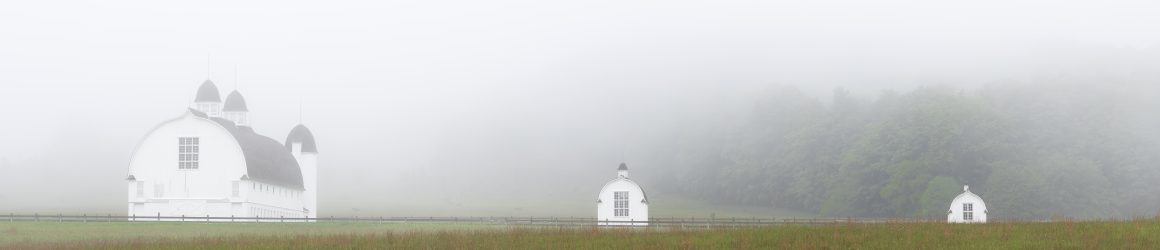
I chose to shoot the setting moon at a familiar spot, the Peter and Jenny Burfiend farm at Point Oneida in the Sleeping Bear Dunes National Lakeshore. Sunrise would follow the moonset by about 15 minutes, so as I stood in a field, the sky became brighter, allowing enough light that the granary was no longer silhouetted.
According to a map I have of Point Oneida, this is the old pig house on the Burfiend farm.
As the sun came up, I was surprised to see the beautiful fall colors still on the trees. This is the house on the Burfiend farm.
After stopping at Bass Lake, I drove to nearby Narada Lake. The corner of the lake near the Sleeping Bear Heritage Trail had a thin layer of ice that would disappear later in the day.
The view across Narada Lake was every bit as stunning as that on Bass Lake.
In the shadows of Narada Lake I saw this reflection of the leaves and a single dead tree that was bleached white.
Lily pads were frozen in ice.
This is the barn on the Lawr farm, which adjoins the Burfiend farm.
George and Louisa Lawr established the farm in the 1890s and and continued to farm there until 1945.
My last site for shooting was along Westman Road, in the wetlands north of Tucker Lake. These berries caught my eye.
The bright yellow tree is a tamarack, also known as an Eastern Larch. Tamaracks are conifers that grow in the wet soils around swamps and bogs and near lakes. Unlike other conifers, each fall their needles turn bright yellow and fall to the ground.
These maples leaves had fallen onto the ice in the wetlands near Tucker Lake.
The weather forecast called for snow on the Leelanau Peninsula last evening. I am sure the next time I venture north, the area will present starkly different things to photograph.
I drove to the Yankee Springs Recreation Area again early this morning not sure whether the peak colors I experienced last week would still be present. I wasn’t disappointed. The trees along Hall Lake were beautiful and the mist rising from the lake added some atmosphere.
I visited the Yankee Springs Recreational Area yesterday, south of Grand Rapids, to catch another glimpse of beautiful fall colors. I set up on the edge of Hall Lake to see what the morning light would bring.
Dew on these branches that overhang Hall Lake catch the first morning light against a backdrop of mist and fall colors.
Reflections of the clouds as they catch the first rays of sunlight.
When the sun rose, the riot of color was revealed.
While I was out seeking fall colors, this scene of leave in the shallows of Hall Lake caught my eye and looked best to me as a black and white image.
On Saturday I headed to Sleeping Bear Dunes National Lakeshore hoping to find fall colors. I got an early start, as usual, arriving an hour before sunrise. Before the sun came up I shot several photos, experimenting with intentional camera movement. No two photos are the same. And sometimes the result is surprising.
The forecast was for a cloudless sky, which was basically true. But this band of clouds appeared and stretched across the sky.
As the band of clouds moved south, it caught the light of the sun, which was still below the horizon.
Shalda Creek flows into Good Harbor Bay. The salmon were running, heading upstream to spawn.
In the northern part of the park, the trees had not reached their peak color, but I was able to isolate some patches of color reflected in Bass Lake.
Birch trees at Point Oneida. The trees are no longer alive. They have been drowned by an expanding beaver pond and now serve as food for the beavers.
Looking down at North Bar Lake from stop number 10 on the Pierce Stocking Scenic Drive. This view shows just how green it was close to Lake Michigan.
The fall colors became much more vivid as I got a bit more inland from Lake Michigan. So I stopped at the Brown Bridge Quiet Area near Traverse City for some quick shots before coming home.
The meadow in the Brown Bridge Quiet Area used to be under a pond that was created when they dammed the Boardman River. The dam was removed in the summer of 2012.